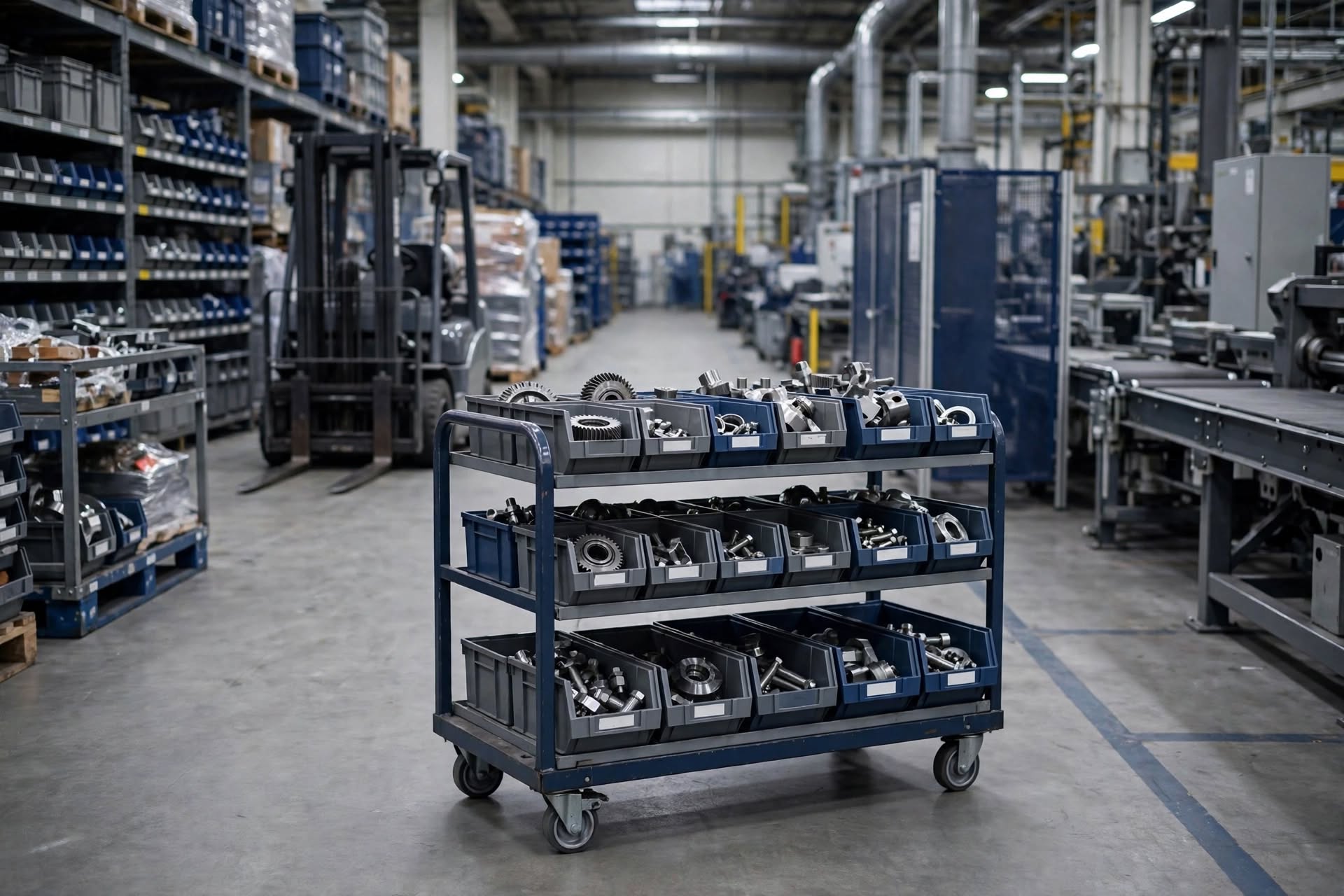
A heavy machinery assembly line does not stop because of a big failure. It stops because a small bin is empty. A bolt, a seal, a bracket — something worth Rs. 500 holds up a machine worth 50 lakhs. That is the real cost of traditional material handling. You have stock in your main store, but it is not at the bay when the fitter needs it. Someone is searching, calling, waiting for a forklift. The line waits. A line-feed system fixes that by reversing the flow. Instead of the line coming to the store, the store comes to the line, exactly when needed. The cost of a line waiting for parts In most fabrication and heavy assembly shops, the process is bulk issue. The store issues 100 gears at once, they sit near the line, get mixed, get damaged, or get lost. Fitters spend 20% of their time searching, not assembling. For heavy engineering, where each machine has a long BOM and variants, bulk issue creates chaos — wrong variant fitted, extra handling of heavy housings, and rework. What feeding the line actually means Line-feed, especially Just-In-Time, means material is supplied to the assembly bay in small, sequenced lots, aligned to the production plan for that shift or that machine. Think of it like this: for Machine No. 124, at Station 3, you need Gear A, Bearing B, and Bolt Kit C in that order. Instead of giving the whole store, we give you a trolley with those three bins, in that sequence, labeled for that machine. It is not more transport. It is less handling and zero searching. From warehouse to trolley This only works if warehousing behind it is disciplined. In our setup, your parts — finished goods, spares, raw castings — are held in our in-house or external warehouse near your plant, managed by WMS. Bin locations, FIFO/FEFO, batch traceability, cycle counts for accuracy above 99.5%. Stock is QC-passed as per your drawings, so only good parts enter the flow. Every morning, we get your shift plan. Our team does: Kitting per BOM: Pick parts for each machine as per BOM, not bulk.Sequencing: Arrange bins on the trolley in the order they are needed on the line.Feeding: Move trolleys via our own fleet or tugger to the bay at the planned time. Empty trolleys return. You get a simple view on your dashboard — what trolley is ready, what is in transit, what is at the bay. No public tracking link, just practical visibility. Why kitting changes everything This is part of our value-added services, but it is core to line-feed. When a fitter gets a sequenced kit, he does not open 10 boxes. He picks from Bin 1, then Bin 2. For heavy components like gearbox housings or large castings, we pre-stage them on a heavier trolley with proper support, so there is no double handling by crane. Result: handling time drops, variant errors drop, and your store team stops being a firefighting team. For one fabrication client, assembly time per station dropped by 18% after switching from bulk to kitted feed. What you get when it works When line-feed works, you see three changes immediately: First, the line never waits for small parts. Because replenishment is based on consumption, not guesswork. Second, your shop floor looks clean. No piles of spares near bays. Only what is needed for that shift. Third, accountability becomes clear. If a trolley is late, you know. If a bin is short, you know. It is not lost in the store. This system connects to VMI naturally. When line-feed consumes, VMI triggers replenishment from vendors, so stock near your plant never goes below minimum. And when combined with our owned fleet for normal and OD, even heavy housings arrive JIT, not just small bolts. Line stoppage is expensive. Feeding the line on time is cheaper than holding extra stock to cover chaos. If your assembly has seen a stoppage in the last month because a part was in the store but not at the bay, it is time to look at how your store feeds the line. Share your shift plan and top 5 line-stoppage reasons — we will map a trolley flow for one bay as a pilot.
OD Consignment Transport — What It Really Takes to Move Heavy Machinery Safely
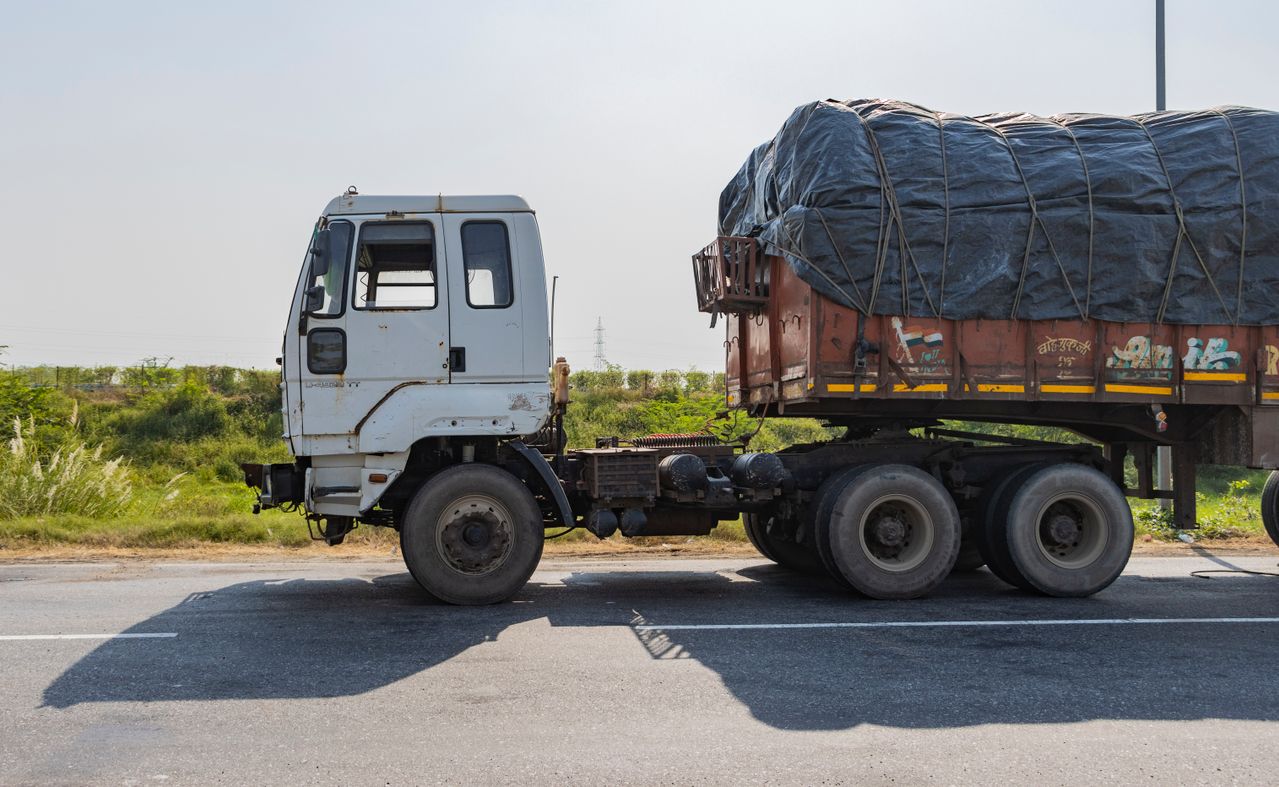
Moving a gearbox that weighs 12 tons and is wider than a lane is not transport. It is a project. For a normal spare, you book a truck. For an over-dimensional consignment, you plan a route, get permits, arrange an escort, check lashing, and then move — slowly, safely, with accountability. One mistake in lashing or one missing permit can cost you a damaged component worth lakhs and a delayed assembly. Why moving a heavy load is different A heavy load is not just heavy. It is often over-width, over-height, and has an uneven center of gravity. A standard truck cannot handle it. It needs a low-bed or semi-low-bed trailer, wooden blocking to distribute weight, and chain lashing at precise points. Even a small shift during braking can damage the job or the trailer. And unlike regular freight, you cannot just take the shortest route. You need to check bridge height, turning radius at tolls, overhead cables, and road strength. What really happens before the truck moves This is where most market vehicles fail. They start the truck first, then think about permits. In our process, we start 2-3 days before: Route survey: We physically check or map the route — where will it turn, where is the low bridge, where will traffic need management? Permits: State-wise OD permits, with exact dimensions. Without this, the load will be stopped at the border. Trailer readiness: Low-bed, axle configuration as per weight, wooden sleepers for load distribution, chain and D-shackles inspected. Lashing plan: Where will the gearbox sit? How many chains, what angle, what blocking to prevent sliding? We make a simple sketch and share it with the driver. This pre-work saves you 2 days of roadside follow-ups. How safety is ensured on the road Once loaded, the load is lashed with heavy-duty chains, not ropes, and blocked with hardwood. Photos are taken for proof. An escort vehicle with beacon and safety cones moves ahead or behind, as per state rules. Speed is restricted. The driver is briefed not to brake hard. At night, the vehicle halts at a safe yard. You get live location through our integrated GPS provider — not just dots on a map, but updates when it crosses state borders, tolls, and reaches your plant gate. This is visibility that matters, not a public tracking link. Why owned fleet matters more here For normal spares, a market vehicle may work. For OD, control matters. With owned fleet, the driver is trained for OD, the trailer is maintained, lashing equipment is standard, and accountability is clear. If something goes wrong, there is no “that was market vehicle” excuse. We run both — normal fleet for regular FG and spares, and OD fleet with low-beds for heavy components like gearboxes, housings, heavy structures. That mix lets us handle a full project — small kits and big main assembly together — instead of you coordinating two transporters. A quick checklist before you hand over your load Before you finalise any transporter for OD, ask for these five: Moving an OD consignment safely is not about finding the cheapest truck. It is about ensuring a critical, high-value component reaches your assembly bay without a scratch and on time, so your line does not wait. We handle normal and OD under one control — from our warehouse near your plant to your store, with procurement, QC, and VMI behind it. If you have a heavy load coming up, share the dimensions and route. We will share the route survey and lashing plan before we quote.
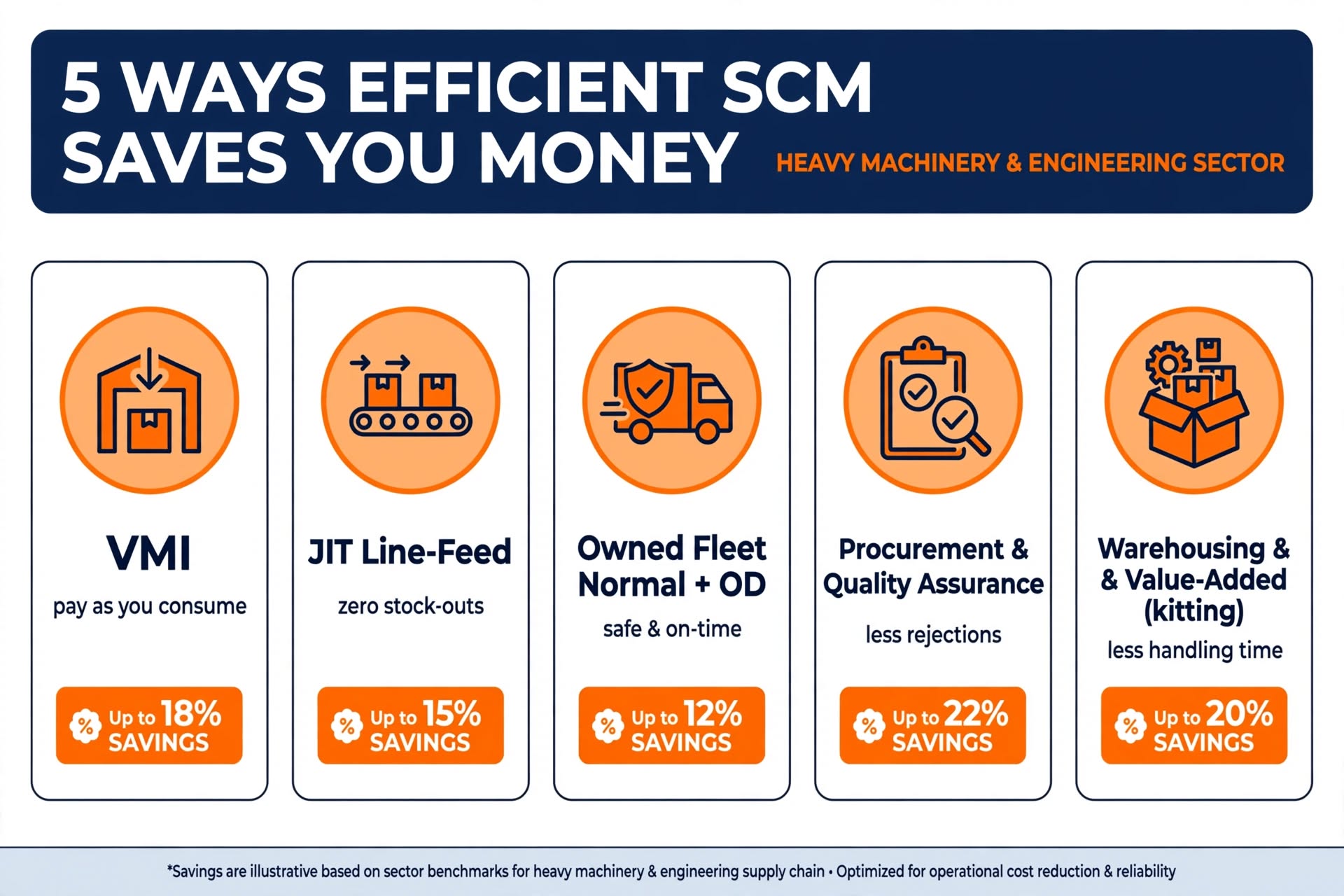
How Efficient SCM Can Save You Money in Heavy Machinery & Engineering
In heavy machinery and engineering, logistics is not about moving boxes. It is about ensuring your assembly line never stops. An inefficient supply chain means stock-outs of long-lead spares, rejections from unqualified vendors, and costly delays in OD consignment delivery. Efficient Supply Chain Management (SCM) is an integrated system — procurement, warehousing, owned fleet, VMI, and value-added services — working as one. Here is how it directly saves you money. image here What is Efficient SCM for Heavy Machinery? For an OEM or Tier-1 fabricator, efficient SCM means stock is available at the place of manufacturing, not just in a distant warehouse. It combines in-house + external warehousing managed by WMS, owned fleet for normal and OD loads, procurement with drawing-based quality check, Vendor Managed Inventory (VMI), and JIT line-feed with kitting and sequencing. GPS visibility is via your integrated provider, not a public parcel tracking bar. How Efficient SCM Saves You Money Through Vendor Managed Inventory (VMI) Heavy machinery needs high-value, long-lead components. Holding them blocks working capital. Not holding them stops production. Efficient SCM saves you money through VMI by shifting responsibility to us. We monitor consumption at your plant, maintain min-max levels, and hold stock near your plant in our own or external warehouse. You pay as you consume. Result: up to 18% reduction in working capital, zero stock-outs, and no emergency air-freight. Saving Money Through JIT Line-Feed and In-Plant Logistics Traditional warehousing pushes bulk material to your store, creating handling and searching time at assembly. Efficient SCM saves you money through JIT line-feed. Material comes from our warehouse as ready-to-assemble kits, sequenced per your BOM, delivered on trolleys to the assembly bay. Less handling, less manpower, zero line stoppage. Clients see up to 15% savings in handling time and OTIF line-feed above 99%. Improving Cost Efficiency Through Owned Fleet for Normal & OD Consignment Market vehicles are cheap until an OD load gets damaged or a permit is delayed. One damaged heavy component costs more than a year’s transport saving. Efficient SCM saves you money through owned fleet for normal and OD consignment. We own assets, control lashing, route survey, permits, escort, and safety SOPs. No brokerage risk. GPS via integrated provider gives you real visibility. Up to 12% saving from avoided damages, detention, and re-work. Scope of Saving in Procurement & Quality Assurance Rejections are expensive — return freight, rework, and assembly delay. Efficient SCM saves you money through procurement and quality assurance. We identify vendors, negotiate, consolidate, and do inward QC as per your drawings and specs before stock enters WMS. Rejection handling and documentation is on us. Engineering clients report up to 22% reduction in rejection rates. Efficient Supply Chain Saves You Money Through Warehousing and Value-Added Services Storing finished goods and spares without process is just rent. Efficient SCM saves you money through warehousing (finished goods & spares) and value-added services. WMS-driven bin management, FIFO/FEFO, batch traceability, cycle counts for >99.5% stock accuracy. Plus kitting, labeling, repackaging, and sub-assembly. You get less handling, faster assembly, and single-point accountability. Up to 20% time saved on shop floor. Bottom Line Supply chain management is not a transport cost. It is a working capital, quality, and uptime strategy. With in-house + external warehouses, owned fleet for normal & OD, procurement & QC, VMI, and JIT line-feed, you convert fixed inventory cost into pay-as-you-consume and ensure material at your assembly point. Ready to see where you can save? Talk to our SCM expert for a warehouse and stock audit.
What is Vendor Managed Inventory(VMI)? A Complete Guide.
If you run a heavy machinery plant, you know the feeling. A critical gear, a hydraulic housing, or a long-lead casting is missing. The assembly line waits. A whole shift is lost, not because you didn’t plan, but because the part was stuck with a vendor, in transit, or failed quality check. Traditional purchasing puts all the pressure on your team — follow up with 15 vendors, track deliveries, hold buffer stock that blocks working capital, and still face stock-outs. Vendor Managed Inventory flips that responsibility. The real problem on the shop floor Heavy machinery is not FMCG. Parts are heavy, expensive, often custom-made to your drawings, and have lead times of weeks. You cannot order them overnight. If you stock too much, cash is locked in racks. If you stock too little, the line stops. Add multi-vendor coordination, drawing mismatches, and OD transport delays, and your SCM team spends more time firefighting than planning. So what does this model actually mean? In simple terms, your supplier partner takes ownership of monitoring and replenishing stock for you. Instead of you raising a PO every time stock dips, we track your actual consumption at your plant or at our warehouse near your plant. We hold the inventory — in our in-house or external warehouse managed by WMS — and you consume as needed. You pay only for what you use. The stock is yours in terms of availability, but the headache of managing it is ours. It is not just storage. It is procurement, quality check, and availability combined. How it works day to day It is a closed loop, designed for heavy components: You get GPS visibility through our integrated provider, but the core value is not tracking. It is assurance. What changes for your team First, working capital. You move from buying and holding to pay-as-you-consume. For one earthmoving OEM we work with, blocked capital dropped by about 20% in four months. Second, zero firefighting. Your procurement team stops chasing vendors. Our team does. Third, quality at source. Only QC-passed material enters your line. No last-minute surprises. Fourth, space and handling. Because kitting and sequencing happen at our warehouse, your store sends ready trolleys to the bay. Less searching, less handling time on the floor. Who should consider it? If you have 10+ vendors for heavy spares, if your lead times are more than two weeks, if you have had a line stoppage in the last six months due to a missing part, or if your store is full but the required part is still not available — this model is built for you. It works especially well for long-lead castings, gearbox assemblies, hydraulic components, and high-value spares that you cannot afford to stock out but also cannot overstock. Common doubts we hear Who owns the stock? We hold it for you near your plant. Ownership transfer happens on consumption, as per your commercial agreement. You get availability without blocking cash upfront. What if my consumption fluctuates? That is why min-max is dynamic. We review it monthly based on your production plan. What about quality? Every batch is checked as per your drawing and QC checklist before binning. Rejected lots never reach your plant. In heavy machinery, the cheapest inventory is not the one you buy at the lowest price. It is the one that is available at your assembly bay when you need it, QC-passed, without locking your cash. That is what this approach gives you — your line keeps moving, your team focuses on building machines, not chasing parts. Want to see if it fits your plant? A quick stock and consumption audit of your top 20 critical spares will tell us.